Today was the last day of my extended (2 week) Christmas 2014 holiday. I wanted to get out for a short ride but the weather forecast the night before suggested frost, so I played it by ear to see what it was like when I woke up. However I had planned ahead and decided that I'd ride over to Rose Hill (or Bilberry Hill as its also known) in the Lickey Hills and do some Hill repeats. The main reason for this was that if it were icy the route over was a bus route so should be reasonably ice free and also its not too far to go. Rose Hill is also a reasonably tough climb (especially in the winter) and although not overly long it's one of those hills that gets steeper as you get closer to the top. Its about 12-13% at the steepest.
I also, completely on a whim decided to wear my Garmin Heart Rate monitor the first time for a long time - I'd given up on it again as it was getting very erratic the last few times I'd worn it much earlier in 2014 - I wrote about some of the issues in this post. Certainly when I first put it on it read 64bpm - I am fit but not that fit.
I had to spend about 5 minutes refitting my front mudguard as I'd removed it to bring my bike back from Dartford where we'd been for a week over the Christmas holiday. It does not fit that well when on the Thule 561 rack - the Crud Roadracer mudguards only take a few minutes to remove so its not an issue. It also took a further few minutes to finally get ready to start and it seemed that this 10-15 minutes helped the strap to read a more sensible value.
It was bitterly cold when I set off but the main roads seemed to be reasonably ice free for the first 5 miles or so. However as I got to the top of Groveley Lane I saw some ice and slush on the road which I managed to avoid but the road was very slippery. I then saw just ahead 3 cyclists waving me down - it appeared that it was so icy that at least one of them had fallen off. I dithered for a minute or so but decided to continue but got off the bike and walked down pavement about 1/4 mile to the railway bridge where the road was OK again. I am not sure why that particular bit of road was so icy though.
From there it was just another mile or so to the bottom of Rose Hill. I dropped onto the 34 inner ring at the roundabout to start spinning up from the very beginning and did the first ascent. It didn't feel too bad at all although I was not trying. The lowest gear I used was the 34-24 (2nd) and rolled up reasonably comfortably. I turned around at the top and mostly free wheeled to the bottom, mindful of potential ice patches. The 2nd and 3rd climbs were also pretty easy, but I was starting to feel it by the 4th. However as I hadn't been lower than the 34-24 gear for all climbs felt I could easily complete a 5th climb. On the last ascent I did use the lowest gear (34-28) but just to be lazy - I could have done it in the 34-24 again but didn't bother.
Once at the bottom for the last time I was originally going to head back the same way I rode over as its quite rolling and as a result its feasible to get over 100ft/mile of ascent. However given the ice on Groveley Lane I rode back via the Bristol Road South to Northfield, then Cotteridge/Kings Norton (past the house in Middleton Hall Road that I lived in for 2 years as a student at Birmingham University), Kings Heath and Yardley Wood.
The new 2015 Strava Segments feature meant that again I picked up lots of 2015 KOM and top 10 placings being one of only a few riders to have ventured out early enough in the year!
Here's the route:
Here's a better picture of the elevation courtesy of Veloviewer:
The actual ride was 94ft/mile which is pretty impressive for this non-hilly urban area of South Birmingham.
Here's some more data from Veloviewer:
Looking at the HR data I am not sure it was working properly for the 1st 1/2 hour. I am fit but not fit enough to keep my HR below 100 - I think once it shows above 130 it was OK. Its also interesting to see where I stopped and walked down Groveley Lane which I have circled in red. Also the max HR at the top of the climb was a consistent 165-169bpm - so I was not working flat out but kept the effort even. I don't trust it to be reliable over a whole ride but it performed better than it had last time - so I might start using it again a bit more often for more challenging rides.
Given that the strap itself costs around £35 I can't justify buying another unless I want to start training a bit more specifically.
Showing posts with label Thule 561. Show all posts
Tuesday, 6 January 2015
Wednesday, 16 October 2013
My Home Made Thule 561 - More Details
A while ago I wrote briefly about my home made version of a Thule 561 cycle carrier here: my-home-made-thule-561-bike-carrier and some pictures in use here: my-home-made-thule-561-in-use and here: bike-transport.
The first version was a disaster. As I described in the first article the base was a Halfords carrier. This consisted of an aluminium extrusion with an pressed steel assembly at one end This is seen at the top of the image, Figure 1.
At this end is also mounted the arms that clamp the down tube. The down tube clamp is the key element clamping the bike to the rack and since it is fixed firmly to the roof bar mounting area it is rigidly constrained. At the other end the bar is constrained with a piece of steel that pulls it down to the roof bar. Figures 2 and 3 show this partially.
This clamp arrangement only pulls the extrusion onto the roof bar and does not provide and torsional resistance (probably by design).
Figure 3a (of a standard design) hopefully shows this as well:
In Figure 3a the arms can be seen to be fixed to part of the rack that is bolted to the front roof bar. Under the rear wheel is the simple clamp that just holds the rack to the roof bars - the rear wheel is strapped to the rack but only to stop vertical movement - any rocking of the frame is managed by the bars to the front mount.
My modification involved removing the arms, and at the other end of the rack mounting the Saris fork clamp, also seen clearly in Figure 1. The fork clamp is mounted to the rack using a piece of aluminium plate which is bolted to a piece of aluminium box section, which finally is bolted to the rack. I chose aluminium over steel because it is much softer and hence easier to work and because it would not need painting or any other corrosion resistance treatment which steel would.
My pieces of aluminium, and their assembly, was fine. I managed to drill all the holes in the right places and bolt it together (using stainless steel screws and nyloc nuts). It resulted in a neat job with no movement. The problem was however that the bike could easily put twist into the aluminium extrusion, as this had no torsional stiffness. With the original design the twisting force transmitted by the arms from the bike "wobbling" is constrained by the wider steel mounting assembly. I had not considered this torsional loading in my original design.
Given that I now realised the torsion problem from the bike to the extrusion, I had 2 options to resolve this:
1 - to move the fork clamp the the other end of the rack so that the torsion was constrained by the mounting plate, or
2 - beef up the fork clamp mounting so that it would be bolted or at least clamped to the roof bar itself
I decided on option 2, partially because I came up with a modification to the mark 1 version rather than starting completely again.
The finished Mark 2 version ended up looking like this, Figures 4 and 5:
Figures 4 and 5 show the development of the carrier by bolting the box section through to a base plate (which clamps to the roof bars) and then stiffening the fork clamp mounting further by bolting the top and bottom plate together. This is achieved by some studded bar and aluminium tube acting as the spacer. This design ensures that all of the load from the bike into the fork clamp is now rigidly constrained onto the bottom plate. The design has proven fully satisfactory.
Here is a picture of it in use:
I am fully confidant of it now - I don't bother using any rope any more - it holds the bike as well as the Thule model. The run to university in September 2013 saw a high speed run (we were late!) in high winds for 170 miles on the M25, M4 & M5 with absolutely no problems.
Further Improvements
There is still an issue with this design. I now have forced the spacing of the roof bars to match the spacing of my carrier design. Most cycle carriers have one end of the rack fixed with the other end floating and I have removed this capability. I think the fix needs to be to mount a slightly modified design at the of the rack. This would leave the original clamp for the opposite end but as it has no need to constrain any torsion this won't be an issue, and it would allow adjustable roof bar spacing.
The final improvement is that some security is required - both for the bike to the carrier and the carrier to the car. On the Thule there is a for locking the clamp that holds the rack to the roof bars and the fork clamp is also secured with a lock. For my design the rack security to the roof bars is by the fact that 8 thumb bolts need to be undone, so not secure but time consuming. There is no way to lock the bike to the carrier. However several months later and purely by chance I saw this product in Halfords:
This is lockable using a padlock though the holes. Its more expensive but a viable alternative to the Saris model I have used .
The first version was a disaster. As I described in the first article the base was a Halfords carrier. This consisted of an aluminium extrusion with an pressed steel assembly at one end This is seen at the top of the image, Figure 1.
![]() |
| Figure 1 |
![]() |
| Figure 2 |
![]() |
| Figure3 |
This clamp arrangement only pulls the extrusion onto the roof bar and does not provide and torsional resistance (probably by design).
Figure 3a (of a standard design) hopefully shows this as well:
![]() |
| Figure 3a |
My modification involved removing the arms, and at the other end of the rack mounting the Saris fork clamp, also seen clearly in Figure 1. The fork clamp is mounted to the rack using a piece of aluminium plate which is bolted to a piece of aluminium box section, which finally is bolted to the rack. I chose aluminium over steel because it is much softer and hence easier to work and because it would not need painting or any other corrosion resistance treatment which steel would.
My pieces of aluminium, and their assembly, was fine. I managed to drill all the holes in the right places and bolt it together (using stainless steel screws and nyloc nuts). It resulted in a neat job with no movement. The problem was however that the bike could easily put twist into the aluminium extrusion, as this had no torsional stiffness. With the original design the twisting force transmitted by the arms from the bike "wobbling" is constrained by the wider steel mounting assembly. I had not considered this torsional loading in my original design.
Given that I now realised the torsion problem from the bike to the extrusion, I had 2 options to resolve this:
1 - to move the fork clamp the the other end of the rack so that the torsion was constrained by the mounting plate, or
2 - beef up the fork clamp mounting so that it would be bolted or at least clamped to the roof bar itself
I decided on option 2, partially because I came up with a modification to the mark 1 version rather than starting completely again.
The finished Mark 2 version ended up looking like this, Figures 4 and 5:
![]() |
| Figure 4 |
![]() |
| Figure5 |
Here is a picture of it in use:
I am fully confidant of it now - I don't bother using any rope any more - it holds the bike as well as the Thule model. The run to university in September 2013 saw a high speed run (we were late!) in high winds for 170 miles on the M25, M4 & M5 with absolutely no problems.
Further Improvements
There is still an issue with this design. I now have forced the spacing of the roof bars to match the spacing of my carrier design. Most cycle carriers have one end of the rack fixed with the other end floating and I have removed this capability. I think the fix needs to be to mount a slightly modified design at the of the rack. This would leave the original clamp for the opposite end but as it has no need to constrain any torsion this won't be an issue, and it would allow adjustable roof bar spacing.
The final improvement is that some security is required - both for the bike to the carrier and the carrier to the car. On the Thule there is a for locking the clamp that holds the rack to the roof bars and the fork clamp is also secured with a lock. For my design the rack security to the roof bars is by the fact that 8 thumb bolts need to be undone, so not secure but time consuming. There is no way to lock the bike to the carrier. However several months later and purely by chance I saw this product in Halfords:
This is lockable using a padlock though the holes. Its more expensive but a viable alternative to the Saris model I have used .
Sunday, 11 August 2013
Bike Transport
We've been on holiday for a week in Suffolk. We took one of my bikes, my son's bike and my wife's (new) bike. This involved 3 bikes on the car: my Giant on the Thule 961, my son's Boardman on my home made 961 and my wife's Trek on an original un-modified Halfords carrier that was the basis for my version of the Thule 961
The biggest problem I found fit this set up was my height. You need to be quite tall anyway to use the standard Halford's carrier and with it fitted to the centre of the car I could only just reach to tighten it up (no handle thing like the current Thule equivalents). I had to resort to using our small 2 step step ladder thing to reach properly, which I then had to put in the car and take with us. More thought later would have identified that I should put this carrier at the edge of the car and not in the centre - lesson learned for next time.
Saturday, 15 June 2013
My Home Made Thule 561 in Use
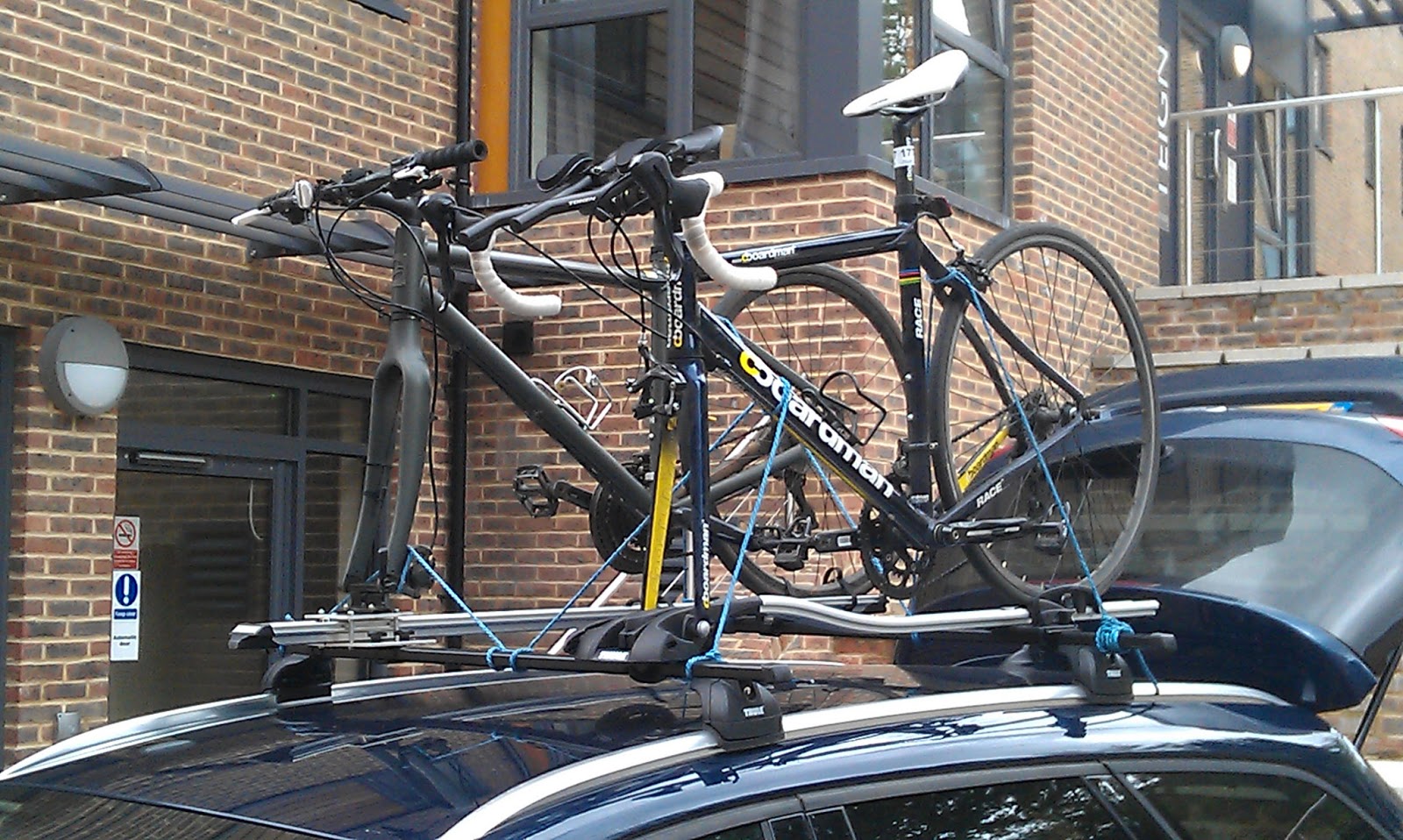
In an earlier post (here) I described the home made version of a Thule 561 that I made by modifying a Halfords roof cycle carrier. Here are some pictures of both my sons's bikes on the roof of my Focus estate - the Boardman in on the Thule rack whilst the Giant Seek Hybrid in on my version.
Being extra cautious I have used some rope between both bikes. The wind was very strong and we had a 150+ mile journey up the M5.
I was very pleased with the performance of my modification
Being extra cautious I have used some rope between both bikes. The wind was very strong and we had a 150+ mile journey up the M5.
![]() |
| The Giant on my version - its not going anywhere! |
![]() |
| The Boardman on the Thule Rack |
![]() |
| Detail of the front fork clamp |
Sunday, 2 June 2013
My Home Made Thule 561 Bike Carrier
Update 17 October 2013 Bit of an update here:My home made Thule 561 more details
Updated 15 June 2013
I am fortunate to have a number of bikes over the years and have bought various racks and carriers to carry them on a car. I initially bought something similar to this (the rack not the bike!):
The one I have is (looks) a bit better than this and in fact I have 2 of these. Its a quite high quality aluminium extrusion with a down tube clamping arrangement, which is lockable. The wheels are secured using self-locking cable straps much like pedal toe-clip straps. The frame clamp is a light weight steel tube.
Advantages of this type of rack are that the bike remains assembled whilst being carried and the down tube clamp provides a degree of stability
Disadvantages are
I also have something similar to this (not quite the same as mine is older):
The reason for getting one of these was that about 12 years ago I was lucky to start having company cars. The scheme I am on is fantastic and means that typically I don't keep a car for much more than 6 months, and I have a wide choice of vehicles (from 2 manufacturers). A down side to this (if there is such a thing!) is that its expensive to keep up with roof bars for all these cars and the days of a universal gutter mounting roof bar are long gone - all modern cars need a special fitting system. As such a tail gate system is a better compromise and fitted all the cars I had. However I was never that confidant about the overall robustness (especially with plastic bumpers) and always used some extra rope for belt and braces through the tailgate hinge to the bike.
In the end, because I wanted to transport my Focus Cayo and did not trust the tailgate rack for an expensive bike I bit the bullet and bought some "quality" roof bars - some Thule ones to be precise for a Freelander 2 I had at that time. I duly had a trial fitting of the bars - I can see why they cost more as they fit really well and securely and fitted my Focus to the roof with one of the Halfords roof carriers as above. I was less than impressed.
I was concerned about the clamping arrangement for the frame - the frame is quite a large diameter which meant that the clamp was awkward to fit and then I was nervous about how much clamp load to apply to secure the bike as it moved more than I wanted even when I had reached the maximum load I felt comfortable with for the clamp. In reality I know that carbon fibre frames are very strong, but a down tube clamp load is not what they are designed for.
The solution for this was a relatively easy solution to get a Thule 561 Cycle Carrier
This is an excellent piece of equipment and is, of the 3 bike carriers I have, by far the best system for carrying a bike. Almost all of the load of holding the bike to the rack is done by the quick release clamp through the front fork. As this part of the bike is designed for high loading then there is no issue with this. The retention strap for the rear wheel is really only to stop the wheel bouncing. The carrier is also very simple and quick to fit to the roof bars. Both fixing points to the roof bar have an adjustable over-centre clamp. The rear clamp is just clamped, but the front is lockable, as is the fork clamp.
I have found with experience that you do need to do these really quite tight or the rack will move slightly.
Once the roof bars are on the roof it takes no more that 10 minutes to fit the 561 and bike and secure it all. It really is excellent.
After a couple of years and the growing interest of my son in cycling it became more necessary to get a second quality carrier like the 561. The easy option would have been to just buy a 2nd one, however being an engineer and having something to start from I felt that I could make one using one of the Halfords units as a starting point. So this is what I did.
The Mark 1
The original plan was to make some form of quick release fork mounting mechanism using a spare front axle that I would fix to the aluminium channel of the Halfords unit. I had given this some thought and had in my mind a fabricated solution of some sort. It needed to be fabricated as I don't have access to either machine tools or any welding equipment, and although my father does have some machines and a gas torch welder these are not easily accessible. Therefore the plan was to make something using various angle and box sections.
However another project I was working on had involved some improvements to my garage and as part of this was thinking about some secure bike racking. Whilst searching for this I came across the following from Saris:
The aluminium was order via an eBay supplier. I got a 500mm length of the rectangular section cut in 3 pieces (2 off 125mm and 1 off 250mm) and some 5mm aluminium plate - a 250mm square cut into 2 off 125mm square and a 125x250mm piece. The reason for the definition of the sizes is that 2 cuts were included in the price. The section was sawn and the plate guillotined, and the sizes were within 0.5mm. I was very happy with the material and the service and would use the supplier again.
This all looked great and worked in the garage. However when fitted to the car a problem came to light. The way the the end of the carrier is fitted to the roof bars is via a metal pressing that rests in the bottom of the V of the section. In normal use this clamp is the rear of the carrier and takes no load, whilst the other end is clamped with a more stiff structure (not shown).
Here is a couple of pictures that sort of show how the rack is clamped at one end - the end I added my new design to:
Given that this end is normally just having the rear wheel sitting in it its a more that suitable design. My design however had the front forks mounted here which put all the side forces onto the extrusion which was not supported
As a result the highest load from the bike is through my new additions, and the design had no stiffness where needed.I t was quite unfit for purpose and a complete redesign was required.
This led to the mark 2 version:
Here are some pictures of a much more substantial version that is fit for purpose.
It was used to bring back one of my sons bikes from Exeter University. 150+ motorway miles with very strong winds proved to be no problem - the bike was securely held and I was very happy
More words to follow describing the reasons for the redesign strategy at a later date.
Updated 15 June 2013
I am fortunate to have a number of bikes over the years and have bought various racks and carriers to carry them on a car. I initially bought something similar to this (the rack not the bike!):
![]() |
| Halfords "middle of the range" roof carrier |
The one I have is (looks) a bit better than this and in fact I have 2 of these. Its a quite high quality aluminium extrusion with a down tube clamping arrangement, which is lockable. The wheels are secured using self-locking cable straps much like pedal toe-clip straps. The frame clamp is a light weight steel tube.
Advantages of this type of rack are that the bike remains assembled whilst being carried and the down tube clamp provides a degree of stability
Disadvantages are
- the bike is very tall when trying to fit to the rack - it was almost impossible on a Land Rover Freelander 2
- the down tube clamp could provide more lateral stability and would be better if the base was wider to give more triangulation
- for fat down tubes the clamp needs to be dis-assembled before it will go round the tube and then needs re-assembly once held around which is very difficult one-handed
- the overall height of the vehicle becomes very tall once a bike is fitted
I also have something similar to this (not quite the same as mine is older):
The reason for getting one of these was that about 12 years ago I was lucky to start having company cars. The scheme I am on is fantastic and means that typically I don't keep a car for much more than 6 months, and I have a wide choice of vehicles (from 2 manufacturers). A down side to this (if there is such a thing!) is that its expensive to keep up with roof bars for all these cars and the days of a universal gutter mounting roof bar are long gone - all modern cars need a special fitting system. As such a tail gate system is a better compromise and fitted all the cars I had. However I was never that confidant about the overall robustness (especially with plastic bumpers) and always used some extra rope for belt and braces through the tailgate hinge to the bike.
In the end, because I wanted to transport my Focus Cayo and did not trust the tailgate rack for an expensive bike I bit the bullet and bought some "quality" roof bars - some Thule ones to be precise for a Freelander 2 I had at that time. I duly had a trial fitting of the bars - I can see why they cost more as they fit really well and securely and fitted my Focus to the roof with one of the Halfords roof carriers as above. I was less than impressed.
I was concerned about the clamping arrangement for the frame - the frame is quite a large diameter which meant that the clamp was awkward to fit and then I was nervous about how much clamp load to apply to secure the bike as it moved more than I wanted even when I had reached the maximum load I felt comfortable with for the clamp. In reality I know that carbon fibre frames are very strong, but a down tube clamp load is not what they are designed for.
The solution for this was a relatively easy solution to get a Thule 561 Cycle Carrier
This is an excellent piece of equipment and is, of the 3 bike carriers I have, by far the best system for carrying a bike. Almost all of the load of holding the bike to the rack is done by the quick release clamp through the front fork. As this part of the bike is designed for high loading then there is no issue with this. The retention strap for the rear wheel is really only to stop the wheel bouncing. The carrier is also very simple and quick to fit to the roof bars. Both fixing points to the roof bar have an adjustable over-centre clamp. The rear clamp is just clamped, but the front is lockable, as is the fork clamp.
I have found with experience that you do need to do these really quite tight or the rack will move slightly.
Once the roof bars are on the roof it takes no more that 10 minutes to fit the 561 and bike and secure it all. It really is excellent.
After a couple of years and the growing interest of my son in cycling it became more necessary to get a second quality carrier like the 561. The easy option would have been to just buy a 2nd one, however being an engineer and having something to start from I felt that I could make one using one of the Halfords units as a starting point. So this is what I did.
The Mark 1
The original plan was to make some form of quick release fork mounting mechanism using a spare front axle that I would fix to the aluminium channel of the Halfords unit. I had given this some thought and had in my mind a fabricated solution of some sort. It needed to be fabricated as I don't have access to either machine tools or any welding equipment, and although my father does have some machines and a gas torch welder these are not easily accessible. Therefore the plan was to make something using various angle and box sections.
However another project I was working on had involved some improvements to my garage and as part of this was thinking about some secure bike racking. Whilst searching for this I came across the following from Saris:
This was exactly what I had been looking for and at £16.99 from Chain Reaction Cycles was cheap enough to take a punt at.
Having acquired the most complex piece rather than having to make it I was enthused to actually finish the project. The plan was to use a rectangular section fixed to the aluminium extrusion and then mount the Saris clamp to that section. Here is a photo of it completed to show the aim.
![]() |
| End-on view of mount showing construction |
![]() |
| Another view to show construction |
![]() |
| Another View |
![]() |
| Overhead view |
![]() |
| Side View |
The aluminium was order via an eBay supplier. I got a 500mm length of the rectangular section cut in 3 pieces (2 off 125mm and 1 off 250mm) and some 5mm aluminium plate - a 250mm square cut into 2 off 125mm square and a 125x250mm piece. The reason for the definition of the sizes is that 2 cuts were included in the price. The section was sawn and the plate guillotined, and the sizes were within 0.5mm. I was very happy with the material and the service and would use the supplier again.
This all looked great and worked in the garage. However when fitted to the car a problem came to light. The way the the end of the carrier is fitted to the roof bars is via a metal pressing that rests in the bottom of the V of the section. In normal use this clamp is the rear of the carrier and takes no load, whilst the other end is clamped with a more stiff structure (not shown).
Here is a couple of pictures that sort of show how the rack is clamped at one end - the end I added my new design to:
Given that this end is normally just having the rear wheel sitting in it its a more that suitable design. My design however had the front forks mounted here which put all the side forces onto the extrusion which was not supported
As a result the highest load from the bike is through my new additions, and the design had no stiffness where needed.I t was quite unfit for purpose and a complete redesign was required.
This led to the mark 2 version:
Here are some pictures of a much more substantial version that is fit for purpose.
It was used to bring back one of my sons bikes from Exeter University. 150+ motorway miles with very strong winds proved to be no problem - the bike was securely held and I was very happy
More words to follow describing the reasons for the redesign strategy at a later date.
![]() |
| The Mark 2 version - end on view |
![]() |
| The Mark 2 version - side view |
![]() |
| The Mark 2 version - another end on view |
![]() |
| The Mark 2 version - yet another end on view |
![]() |
| The Mark 2 version - another side view |
![]() |
| The Mark 2 version - end on view |
Subscribe to:
Posts (Atom)