Sunday, 31 March 2013

UK Riding

This site: http://www.jonathanokeeffe.com/strava/map.php allows you to plot all your routes uploaded to Strava and see where you have ridden. Its great. Here is my ride data since 1 Jan 2011:


As you can see they are centered around the south West Midlands, but I have also ridden:
Dartford (Kent, parents house), Exeter (son's university), Sheffield (other son's university), Bath/Mendips (Wiggle Sportive), Stoke on Trent (Tour of Britain Sportive), Cardiff (prospective university), the Wiggle No Excuses Sportive and a Birmingham to Oxford ride.

I have ridden in France and recorded the rides on my Nokia using Nokia Sportstracker but I didn't keep the original data, so I have lost speed etc and can't upload these rides to Strava.

However I did upload them to Google Earth:


These are all the rides from mid 2009 to about November 2010. These show riding in Normandy and the Isle de Paris, the 2010 Dragon Ride (Medio route) and the 2010 Tour Ride Stoke. I also rode from Solihull to Milton Keynes one day - my sons went snowboarding so I rode down.

Sunday, 24 March 2013

Drive Train upgrades:

"Don't by upgrades, ride up grades"

I like to do a bit of bike tinkering - the good thing about my two bikes is that they are not excessively expensive in the scheme of things and I can afford a few upgrades now and then. What normally happens is that I get something new for the Focus and the original Focus parts move down to the Giant. As a result the Giant is a bit like Trigger's Broom - I have had the same bike for nearly 4 years, but the only original parts are: frame and forks; brakes; handle bars, seat post, saddle and cable outers. Everything has either been upgraded or replaced as it wore out (the most recent example of wearing out being the bottom bracket, see earlier).

Rear Dérailleur Upgrades

As a result of all these progressive upgrades the Giant ended up with the original 105 mid cage rear dérailleur from the Focus - a perfectly good piece of equipment and probably a lot better than many people have but my issue was that it never quite looked right, and this was why I had swapped it from the Focus in the first place. I was therefore hankering with changing it. 

I did this by buying a new 105 5701 rear dérailleur for the Focus and moving the 5600 dérailleur from the Focus to the Giant. This was relatively straightforward and did not really have any major implications. Although I expected the 2 dérailleurs to be basically the same geometry and differ in appearance actually the 5701 dérailleur is slightly different. The jockey wheels are further apart that the 5600 model and actually the jockey cage is about 1/2 way between the 5600 short and medium models. I guess this is what is needed to work with an 11-28 cassette range which the 5701 model supports "officially". However I never had any issues with a 5600 short cage working with an 11-28.

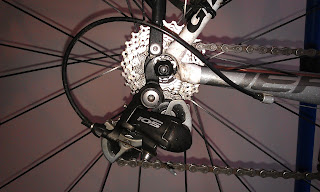
Here are some pictures, before and after for the Focus and after for the Giant (I used my phone so they are not great quality):

 Focus:


5600 - Small Front, Smallest Rear
5600 - Big Front, Smallest Rear
5700 - Small Front, Smallest Rear
5700 - Big Front, Smallest Rear
5700 - Big Front, Biggest Rear

With the 5700 deraillieur the chain looks a little short - this is because the chain is the same length as used for the 5600 model and this shows that he cage is longer, however I don't have a photo of the 5600 in Big/Big to provide a direct comparison.

Giant:
Giant - 5600 Short Cage, Big Front, Smallest Rear
Giant - 5600 Short Cage, Small Front, Smallest Rear


Giant - 5600 Short Cage, Big Front, Biggest Rear
Note I don't ride it in Big-Big! Given that I was going from a 27-25 tooth and taken off a long cage mech I took out a few links without measuring up, with hindsight I should have checked. However the chain is almost at the end of its life so I'll measure up a new chain in the coming month or so.

Giant - 5600 Short Cage, Small Front, Biggest Rear


Cassette Selection

I also knew that the rear cassette on the Giant (also originally from the Focus) was at over 6000 miles and that the gears I used most (3,4,5) were pretty worn (there was a noticable deterioration in shift quality and so needed replacing. Again not being a super powerful rider some of the gears were pretty pristine whilst others were pretty worn. However it does not seem possible to replace the individual gears and if possible it works out at a lot more cost than a new one - a symptom of our throwaway society I guess.

The choice of what to get was a much more difficult decision than the mech as there is a choice of 4 105 10 speed cassette ranges to choose from, namely:

11-25, 11-28, 12-25 and 12-27

The gears are:
11-25: 11, 12, 13, 14, 15, 17, 19, 21, 23, 25 
11-28: 11, 12, 13, 14, 15, 17, 19, 21, 24, 28
12-25: 12, 13, 14, 15, 16, 17, 19, 21, 23, 25
12-27: 12, 13, 14, 15, 16, 17, 19, 21, 24, 27

I run an 11-28 on the Focus and a 12-27 on the Giant (originally from the Focus as well). I was not that keen on the 11-28 and really only wanted a 12-28 for the 28, not the 11 as I can't exploit the 11 tooth gear as I am not strong enough. Ideally I would have liked a 12-28.

The choice of a new cassette for the Giant was quite difficult. I use the Giant in the winter and throughout the year to commute so don't do very long or hilly rides. During the Winter of 2012/2013 I was managing with the 27 as the lowest gear quite satisfactorily and even managed some of the local climbs on the 25 when it wouldn't shift down to the 27 on one ride.

This suggested that on most rides I could manage with the 25 as the bottom gear. I also felt that a 12-25 would force me into a slightly higher gear and build a little more strength as it is too easy to bail out onto the 27 or 28 when it was there. I also was slightly keener on the 16 tooth the the 12-25 has that is missing on the 11-28 and this makes quite a jump for an distinctly average rider like me.

The alternative view was that if I rode a 11-28 on the Giant as well I then had a spare for the Focus and had the same gearing on both bikes meaning better consistency.

Any way after a lot of dithering I got a 12-25.  Cosmetically it looks a lot better (see pictures above). I have not yet ridden many miles on it yet but I have commuted to work on it and did not really notice any difference. I felt that I changed gear more often - partly because I found all the gears a little closer and also because I am not as bike fit at the moment as I have been. Only time will tell

In reality of course its not impossible to build a 12-28 or other combinations - although it would be quite expensive.  The biggest 3 gears are all on a unit carrier and all 4 cassette ranges have a 21 as the smallest gear on that carrier, and all use a 19 as the next gear, so given enough money and time one can build a cassette with ant combination of 11, 12, 13, 14, 15, 16, 17 and 19 and then select 1 of the 4 3 gear sets.

Tuesday, 19 March 2013

The Rawlinson Bracket

The Rawlinson Bracket

This was a Sportive set up by a colleague at work in memory of another colleague who died unexpectedly last year. There is a link to the site here: http://www.the-rawlinson-bracket.co.uk/ and they have a Facebook page as well: https://www.facebook.com/TheRawlinsonBracket

This was really well set up and organised and full credit to Steve and the team for the event that they created. It was a very challenging route with a lot of climbing over the 50 miles. It was also very very cold - barely above 0 Deg C for the entire time. However the turn out was excellent - almost 300 people I believe for an event at the end of February so a really good achievement.

As I said, the route was tough. I have ridden Edge Hill a number of times so knew what I was in for, however there were then a number of other hills before turning back to climb Sunrising Hill which was about 7 miles from the end. I have ridden Sunrising once before and knew that it would be really tough especially after 40 miles before, and therefore tried to conserve some energy all the way round just for this last climb. However the endless climbs and very cold weather really took it out of me and as I have done very few miles this year I found Sunrising every bit as tough as I expected. After dropping back off Edge Hill the run back to the start (at the Heritage Motor Museum) was a real grind and to be honest I just followed Noel all the way.

At the end of the ride I was just glad to finish and start to warm back up. Looking back I think that I did really enjoy the route, but not in the cold. I normally ride throughout the year but I can't remember if I have ever ridden for so long at such a low temperature.

The Strava data is here: http://app.strava.com/activities/42085452

This is me looking pained at the top of Edge Hill:


Wednesday, 6 February 2013

Strava - Excel Download and Analysis

Update4 Jab 2014: Please see here: Strava API 1 withdrawn

Last updated 8 Feb 2013

Here is the 1st release of my Excel based Strava download tool. It works for me but it must be accepted that it is very much a Beta release. There are 2 parts to the solution - the first part is Excel file itself and the second part is the file "wget.exe".

wget.exe is a free tool to get all or part of a web page. More information can be got from here: wget software. As its says:

GNU Wget is a free software package for retrieving files using HTTP, HTTPS and FTP, the most widely-used Internet protocols. It is a non-interactive commandline tool, so it may easily be called from scripts, cron jobs, terminals without X-Windows support, etc.
GNU Wget has many features to make retrieving large files or mirroring entire web or FTP sites easy, including:
  • Can resume aborted downloads, using REST and RANGE
  • Can use filename wild cards and recursively mirror directories
  • NLS-based message files for many different languages
  • Optionally converts absolute links in downloaded documents to relative, so that downloaded documents may link to each other locally
  • Runs on most UNIX-like operating systems as well as Microsoft Windows
  • Supports HTTP proxies
  • Supports HTTP cookies
  • Supports persistent HTTP connections
  • Unattended / background operation
  • Uses local file timestamps to determine whether documents need to be re-downloaded when mirroring
Any way - you don't need to know the technical details, just follow the instructions below. 

Download it from here: http://sourceforge.net/projects/gnuwin32/files/wget/1.11.4-1/wget-1.11.4-1-setup.exe/download

Create a folder where you want to run the Excel file from. I have used:
"\Documents\Strava API Release" but the choice is yours.


Copy the Excel file from here: https://docs.google.com/file/d/0B3SjSCZb92mybVF3VEVhNHFYVjQ/edit?usp=sharing.

Note that this link opens the Excel file as a Google Doc as follows:


Press the "down arrow" button (circled in red) to download the file into Excel on your PC. Save it to the location you want (see above) and also copy in wget.exe to the same folder. These are the only 2 files you need.

Open the  Excel file. Make sure that you allow macros to run:


Hopefully you will see something like this:


You only need to enter your Strava Athlete ID in the yellow box and then press the button "1 - Get All Ride Details". You can add your name in the cell above if you want - it's not currently used.


Then wait!

The macros will run. It works by generating a set of batch files that call wget. You will see command windows open and close as the data is fetched from Strava and then processed. It's not pretty. wget returns a text files and these are processed by the macro to extract the data which is loaded into the sheet.

You'll see something like this - once for each block of 50 rides and then once for each segment:


It takes several minutes to run on my laptop to retrieve 320+ rides.

Firstly top level general ride data is retrieved and added to columns B to E in sheet "Summary". Further data for each of these rides is then added ride by ride on the same sheet to columns F to N and this reports data such as distance, average speed, height gain etc for each ride

Secondly having all the ride data, it then retrieves all the segment data for each ride. This is written to sheet "Efforts". This sheet has filters applied to the columns. This allows you to create a filter for each segment.

I have also added 2 graphs - one is "Avg Speed vs Distance" - this is just a scatter plot for average speed against distance for all rides, and "Avg vs Date" which plots average speed vs date. Can you see an improvement as time goes by or is it too depressing to look at!

Each time it runs it creates a lot of files in the folder: these are the batch files it uses to run wget, and the text files created by wget each time it is run. These may be deleted if required.

Further developments:
  • More configuration options (easy)
  • Check compatibility with Excel 2007 and 2010 (possible)
  • Select rides in a date range (easy)
  • Provide update option - only get new rides since last update (easy)
  • Delete files at end of update (easy) 
  • Error trappping (easy)
  • Better performance (possibly easy)
  • Automated analysis (easy)
  • Remove Need for wget (hard) 
  • Comment and improve the VBA code quality

These might be easy but is more about time than programming knowledge.

Tuesday, 22 January 2013

Strava Data Analysis

Earlier this year I wrote a programme to download data from Strava into Excel so that I could analyse my rides. It's still a work in progress and a bit flaky but I'll post it soon when I have improved the user interface and written some "documentation".

In the meantime here are some screen shots:


Rides data

Segments Data

Sample Graph - Average Speed vs. Date
The alternative is to use the excellent veloviewer page:


Monday, 21 January 2013

Shimano 105 Shifters Revisted

Caution - Work in Progress!! 

Further update here: Building new bike part 3 observations

A while ago I wrote a short piece about the experiences I had when I fitted Shimano 105 5700 series shifters to my bike to replace the 5600 series originally fitted.

The reason for the change/upgrade was that I really wanted to upgrade my other bike (Giant Defy 4) to 10 speed and whist I had the cassette, chain and dérailleurs for the bike I did not have any spare shifters. As these are by far the most expensive part of the drive train it took a long time to decide on the correct strategy to get 10 speed on both bikes for the least amount of money but best compromise seemed to be to upgrade the shifters on the Focus and move the original shifters to the Giant.

The Focus came with the 5600 series parts, but at the time I was looking into this the newer 5700 series had been around for about a year. Part of the decision was also that it appeared increasingly difficult to get the 5600 parts, although they were slightly cheaper. From what I could make out the most prominent differences between 5600 & 5700 parts were that the 5700 had the shifter cables running under the bar tape alongside the brake cables whilst the older 5600 has the shifter cables coming out of the side of the shifters.

Here is a picture of each:

5600

5700


More subtle differences are apparently a more ergonomic shifter design and different pull ratios for the brakes and front dérailleur, although seemingly not the rear dérailleur. Because of this it is seemingly necessary to run a full 5700 system with the new shifters.

The pull ratio change was difficult one to find out more about. Given the physical dimensions of the shifters and the basic geometry of the brake caliper it was hard to see how different it could be. A search of the internet was not particularly helpful either. All of them basically say what I have summarised above.

After much heart searching (and internet price comparisons) I bit the bullet and bought a pair of the 5700 shifters for the Focus. I did also decide to get a 5700 front mech as these are relatively cheap.

I waited until the bad weather around Christmas 2011 (when I had some spare holiday to use) and fitted the parts to the bikes. Given that it was winter I did not ride the Focus for several months but the Giant carried on being ridden. I didn't notice any change to the Giant compared to the Focus (after all it has the same parts fitted), although up-shifting on the rear is not always as crisp as I remembered - it will either not quite shift up a gear and need a slight extra nudge, or will shift up 2 gears when only one is requested. I think this is due to a little wear on the right shifter but also because the medium cage (GS) rear mech is not as stiff as the short cage. Any way I live with it as I think it's one of those jobs that could absorb hours without making it any better.

However on the Focus all was not quite as well. Firstly the upgrade was completed before Christmas so it was not ridden. Testing the bike in the work stand suggested that the front mech was quite stiff to shift up to the big ring and sprung back very "positively" when dropping onto the small ring. Its really hard to get a good feel in the workstand as your hands are not in the normal riding position. I had a fiddle but left it until I planned to ride it again when I would have a better view.

Because of the weather I did not ride the bike until early March and this really highlighted 2 things - the back brake was pretty well in-effective and the lever load for the front mech was very high.

The back brake issue is discussed here: Shimano 105 5700 mechanicals (as is the first draft of this review) and seemed to be related to a rusty brake cable. My view of the front brake performance comparison between the original (6600?) Ultegra and the new 5700 105 calipers is that if there is a difference its almost undetectable, and probably more affected by rim/brake pad combination than the pull ratio.

I have also looked more at the front mech load - it "feels" at least twice as hard to shift up a gear than the 5600 combination. With the cable disconnected and moving the mech by hand it does not feel excessively stiff, but via the shifter is harder than the older model. The cable routing around the bottom bracket is identical to the initial install, and learning the lesson from the rusty brake cable I have checked the cable - both for rust, cleanliness, smoothness of outer cable, cable radii etc and can see nothing wrong. I am sort of resigned to it. Most of the time where I live I can ride on the big ring most of the time so its not that I am making dozens of changes a ride.

Despite the disappointingly high front shifting load the rear shifting is excellent - much better than the 5600 (and I am still using a 5600 105 short cage rear mech) - up and down it never misses a shift, very slick and positive.

When I do another major service I will probably change both inner and outer front cables regardless and try that to see if it makes any difference. I am not sure if the cable run from under the bottom bracket affects it - I'll post a photo another time, but it's the same as before.

So - does the pull ratio change make a difference?
  • Front brakes - no
  • Rear brakes - no
  • Rear mech - no
  • Front mech - I can't tell but the shifting load is high
Hope this helps

Sunday, 20 January 2013

The Rawlinson Bracket

A colleague at work has set up a Sportive to remember another colleague who sadly died suddenly and unexpectedly last year.

This is it: The Rawlinson Bracket

I have signed up (hopefully with Noel)

Its for a good cause and looks challenging