Showing posts with label StravaDotNet. Show all posts

Sunday, 20 June 2021

Strava Data Analysis Tool - sort of Version 4.x

First 2021 Update

Since the better weather arrived in April 2020 I have spent a bit more time cycling than tweaking my Strava Data Analysis Tool. However I am always making a few updates in the background and over the past few months I have made a number of changes making it worth issuing an update

You can get the update here: Link - Strava V4 - Full Installer.zip

The main changes are as follows:

  • Some improvements to the GUI and redrawing the various tab pages when selected
  • Some minor error fixes
  • GUI improvement with an informational form popping up when downloading the Ride Meta data (which is a single long operation and I can't report and form of % progress)
  • Many minor tweaks and changes that I have forgotten about due to poor tracking

I am the limit of the features that I had thought about implementing and there are very few left to do

I need to revisit the Authentication code which now does not seem able to re-authenticate automatically

I also want to integrate my fit file reader and tcx reader code into the same application so that if you don't use Strava but do have a device that creates fit or tcx file you can still use the tool and get the data and analysis 

Next steps are I think a "start from nothing rewrite" and implement all the coding learning I have made over the past 2 years  - I now know that I need to plan better, and split the code into more smaller classes that are easier to manage. I'd also like to look a optimising some of the code - there are bits that seem to take ages when I think about what they are doing. I appreciate that looping through tables of data with 1000's or rows will have a performance impact but it seems 

It's become a huge code base that's all intertwined and it takes a lit longer than I know it should to make changes as it's hard for even me to follow - and I wrote it!

See previous posts for instructions here:

Post 1 - Posted 11 December 2016
Post 2 - Posted 7 January 2017
Post 3 - Posted 4 December 2017
Post 4 - Posted 22 April 2018
Post 5 - Posted 25 April 2019
Post 6 - Posted 4 May 2019
Post 7 - Posted 15 June 2019
Post 8 - Posted 6 March 2020
Post 9 - Posted 15 March 2020
Post 10 - Posted 29 March 2020

You can see here the erratic nature of my development pace!

Friday, 6 March 2020

Strava Data Tool Update March 2020 - V3


There's been a lack of visible progress on this application for 6-8months

This is partly because:
  • the weather was good over the summer and I'd much rather be outside
  • I've written the Di2 decoder application for a change of programming focus ("a change is as a good as a rest")
  • and I have also been making significant changes to the Strava Data Tool "under the bonnet" based on learning from the TCXConverter and Di2 Decoder apps that I wrote and could see benefits in making it easier to mainatin the Strava Tool
  • The Strava tool grew organically making it a nightmare to edit and change the code - this is because I wrote it learning as I went and adding feature ad-hoc and hence there is no design to the code
However the dark winter weather meant that I have been back on this with quite a lot of effort over late 2019/early 2020

I also thought ready to release back in February 2020 but some last minute tetsing showed a major issue when creating a new database. It took me a long time to work out the change that caused this, which was in fact trivial and related to changing to a static SQL class and getting confused with the constructor behaviour

Although the app looks almost identical there is a big change list which includes the following (not-exhaustive) list
  1. Only raw data stored in the database (~60% reduction in database size and improved performance)
  2. Use of SQL_BLOCKCOPY to load data to database tables)
  3. Consistent use of DataTables throughout the app, and programmatic creation of these rather than predifined. Also the Datatable definition are used to programmatically create the Database tables menaing a much greater level of consistency and alignment
  4. Conversion to static for a number of common classes
  5. Introduction of a static Global_Constants class to improve maintainability and readability across the application
  6. A lot of code tidying up
  7. Removal of redundant methods- so the code base is now smaller

  
There's still a lot of improvements to be made:
  1. The most major issues seems to be a change with the authentication process that is less seamless than it was a few months ago - I have yet to resolve this. When you start the application for the first time it will open a web page asking you to approve access to (your) data. This is as designed. However if you then close the application or don't use it for a further 6 hours the application needs to re-authenticate - this is as required by Strava. In theory th eapplication should use one of the tokens set in the first initialisation and silentrly re-authenticate. However it doesn't and it throws an exception "Error #3000 during Web POST, Authentication_Web_POST/Get_Tokens". However if you select OK it will then open a web page and re-authenticate. I need to look at this more
  2. Some database tables still need "re-formatting" to the new process
  3. Lost the ability to export the graph as an image (as I changed how the export feature worked)
  4. Better logging format and verbosity - although its better, it's still a mess
  5. More testing and error trapping - again it's a lot better but still not exhasutive
  6. The redraw code still does not function correctly
  7. Further code general improvements- readability, structure, style etc.
Some features to be added include:
  1. Adding the ability to (manually) load di2 data from a .fit file and asscoiate with existing down loaded data, inluding the statistics and graphical displays (i.e. incorporate my Di2 Decoder application into this application
  2. Adding segments data
  3. Refining the statistics - I think allowing a level of user query building would be good (to an extent). Also getting data per bike and ride type for example - i.e. how many miles in 2019 on Bike X on a trainer
  4. Fixing some of the things athat are still broken

Anyway here are the links to the program
  1. The standalone .exe file is uploaded to here:Link to V3 standalone exe Zip file
  2. The installer package is uploaded to here:  Link to V3 Full installer - Recommended


I strongly recommend using the installer - its been tested and works as I expect it to

As far as I can tell there are no viruses in the zip and there is  no spyware - it just reads your Strava data

Best Help page is here: Notes from release 2.0.0.0


Saturday, 4 May 2019

Stava data Tool

The Latest Version is here: Strava Tool V3

Please use this version 

This is a page as to how to install, set up and use my Strava Data Extraction Tool.

First get the installer files from here. Extract the files from the zip file and you should see these files:


Double click on Setup and the application should install correctly. It might even auto run - I have had inconsistent behaviour with this. Also for some reason the application is called "Strava Forms V2.exe":

I say "for some reason" but obviously I have not packaged it correctly. You could create a shortcut for this t make it easier if you wish

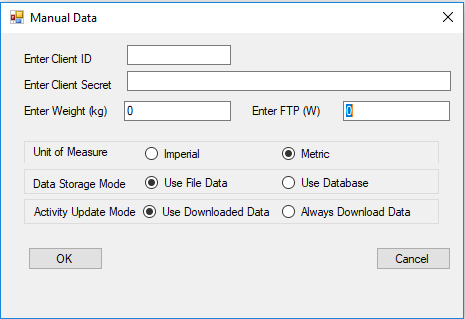
The program uses an old fashioned .ini file for configuration data. If this is not present (it won't be for the first time its run) it will open the configuration dialog box as follows:


You will need to enter the Client ID (use application identifier) and the client secret as a minimum. The application will check if you have not and keep the window open. This is also the case for the Weight and FTP entry boxes

The check boxes need not be altered if required. These settings are as follows:
  1. Unit of measure - default is metric, can be changed to imperial (statute). Note this is effectively a one-off setting and I don't think (I have not tested) that once the application is running it swaps between the 2 as required. This is a future development, it might work for database mode but definitely not file mode
  2. Data Storage mode - default is File based data, can select Database (SQL). I would recommend Database mode as I have done more work with this option and will do more development using the database
  3. Activity Update Mode - can save bandwidth and time - Use downloaded data means if that data already has been downloaded it will use this data, else it will re-download the data again.
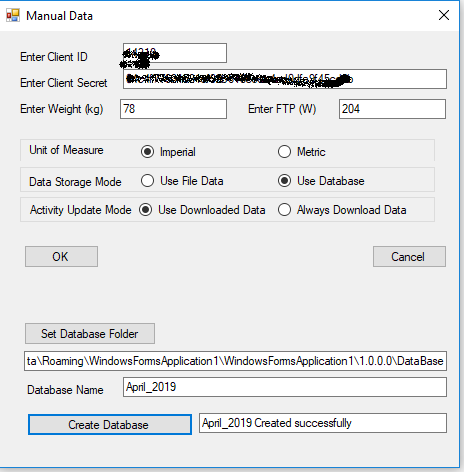
If you select "Use database" the dialog box will increase in size and options to create a database will appear:


Here you must select a folder and specify a name for the database (note please do not add any file extension, just a name) as follows:


Then select "Create Database" and all being well you will see this:


Once you press "OK" the application has enough configuration to start. It will initially try and Authenticate and you will see the following:


Note the Access mode is selected as "activity:read_all". This is the default option and will not allow you to read activity data if this is not selected. The application will connect to the Strava authentication process immediately and all being well a web browser window will open which you need to accept (or not):

Press Authorize and hopefully the the web browser window should automatically change to something like the following:

This is part of the returned authentication data and shows the current access token (there is other data returned that I did not show). It is this code that will allow access for the next 6 hours. The status bar data updates and will now look something like:

You will see that Athlete data has been obtained and displayed. The status bar now shows when the current token will expire, how long is left and that fact that it is authenticated.

In theory, before the 6 hours is up it will re-authenticate itself automatically. This is not tested.

The application data folder is set automatically by the installation and is in a place almost impossible to find. There is quite a lot of benefit to opening this folder so the application will open it for you on demand:


The "Show Data Option" will open the folder. The other options will be described later.

Note that the application does quite a lot of automatic information and error tracing. This is a file per session called "Traceoutput_YYY-MM-DD_hh_mm_ss.txt" and is created in the Data Folder. These can be useful in the event of issues. These can get quite big.

The next step is to download the Activity Data - this is the summary data about all the activities that have been uploaded to Strava between 2 dates. The default start date is an arbitrary 1 June 2018 and the end date is today's date. These are standard Date Pickers so can be changed.

Select the start and end dates of your choice:


And then press the "Update" button. Depending on the number of activities it will take some time to get and process the data. The application is unresponsive during this period and it cannot be stopped. Once the data is downloaded and processed you will see something like the following:


There will be a graphical display of ride count, distance, elevation and activity duration against date. This is also tabulated and a summary of the distance on each bike is also presented. Note that this is only the summary data of the activity - NOT the time based data recorded during the activity. To get this select the tab "All Ride Activities (nnnn rides)". nnnn will depend on how many rides you have uploaded:


This will show the summary data for each ride (newest first). Black text is that none of the time based data has been downloaded, blue text shows that time base data has been downloaded to the database and red text shows that time base data has been downloaded to a data file.

To get the time based data select the left most empty column next to the activity for which you want the data and double click:


This will down load the data for this activity and it will be shown in the other tabs.

The raw data is shown in a textual format in the "Ride Activity Data ID:xxxxxx" tab:


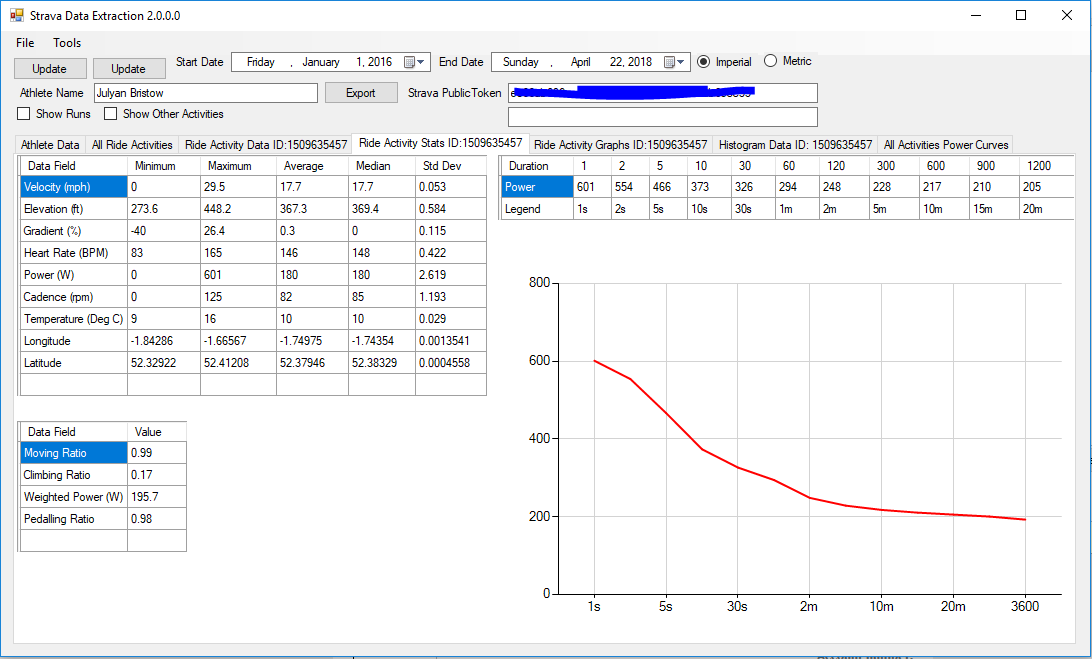
More detailed statistical analysis of the data is shown in the "Ride Activity Stats ID:xxxx" tab:


The data is presented graphically in the "Ride Activity Graph ID:xxxx" tab:


Histogram data is presented in the "Histogram" tab:


It is possible to automatically download the time based data for all activities. From the menu Bar select the Tools menu and select "Download All Activity Data". This will the download all the time based data and process the statistics. Note - this is slow - you can expect an hour or more if you have many 100's of activities. There is a progress indicator and the application is partially responsive during this task:


Note that bandwith/number of requests is limited for this sort of Application. I have not implemented code to check this and ensure that it pauses when the limit is approached. However in my experience I can set the application to download all the data and it will not fall over by hitting this limit.

You can review the rate on your Strava "My Application" page from the settings page:


Note that there is a LOT of data needing to be stored when you select the option to download all the data. The application reads the raw data, which it stores and it also writes the imperial and metric data in the database as well (to save time when viewing the data). I have ~1500 activities and the SQL data base is ~1Gbyte in size to store this, so please be aware.

There is an option from Tools Menu to view the database size:


You can also remove all the data from the database using the "Delete All Rows" button - use at your peril as you'll have to download it again!

MORE TO FOLLOW

Thursday, 25 April 2019

Strava Data Analysis - A PC Based Visual C# Solution - V2_1_1_0_66 April 2019

The latest versin is here: Strava Tool V3

Please use this version

Update - now authenticates programmatically

As per the previous post I have now included programmatic Strava Authentication for the application to take account of the October 15, 2019 change where "Forever tokens are rejected by the server. Old OAuth endpoints for obtaining forever tokens are removed." I have been using a "Forever Token" up to this point.

The new version can be downloaded from here

Some other  changes have been made. Some bugs have been fixed and I am sure some other bugs will have been introduced. I do use the application myself and its not broken anything yet...


Please, if you use the software use the comment section to let me know what you saw. Add the Traceoutput files (in the application folder) to the message

At this moment there is no documentation for this version - this will follow soon

See the new Authentication data at the bottom of the application main window:


Sunday, 7 April 2019

Automatic Programmatic Authentication to Strava in C#

Note: this page was started 7 April 2019 and has been updated 22 April.

This latest update is to confirm that this code gets the correct access and refresh tokens which, when used to connect to Strava, will get data according to the Scope selected. 

I was getting a "401" error when trying to get Activity data. However this was because I was using
Scope: read_all which reads "private routes, private segments, and private events for the user".
I.e. it does not read Activities for which you need:
Scope: activity:read_all "which is the same access as activity:read (i.e. read the user's activity data for activities that are visible to Everyone and Followers, excluding privacy zone data), plus privacy zone data and access to read the user's activities with visibility set to Only You"

This means that this code is a functional (if inelegant, badly written, poorly documented etc) route to get the access tokens needed from October 2019

The Windows PC programme I have written in C# to get my data from Strava and display and analyse in a variety of ways (latest Blog post here: link) has a relatively major failing - that is that it is necessary to manually go through a number of rather non-intuitive steps to get a Strava Access Token. Although its not elegant it was a one-off task until this year. 

In October 2019 the Strava Authentication method is changing from a non-expiring token (as per my application when I created it) to a time limited token process which then involves re-authenticating every 6 hours. This is described here: link

Whilst my application will continue to work (for me) until Oct 2019, using my original non-expiring token, at this point I will need to move to the new process of this time limited token exchange.

Anyone wanting to use my application now and follow the process I have documented in the blog will find that they they probably can manually get a token using a similar process it will be a pain and then that token will expire 6 hours later.

Therefore to address this I have started to develop a proper authentication solution as I have no choice. I approached this by writing a separate application to test the process and methodology, and then once I had a working system integrate into my original application. I also created a separate Strava account to test this with rather than risk corrupting my current account access and losing my data (more on this later).

As before I created (in my new account) an application and registered it. This is documented here: link and here: link

I then spent some time reading the documentation to see how it worked. I also manually typed in the html code/links directly into a browser to look at the response so I understood what you needed to send and what answer you got back


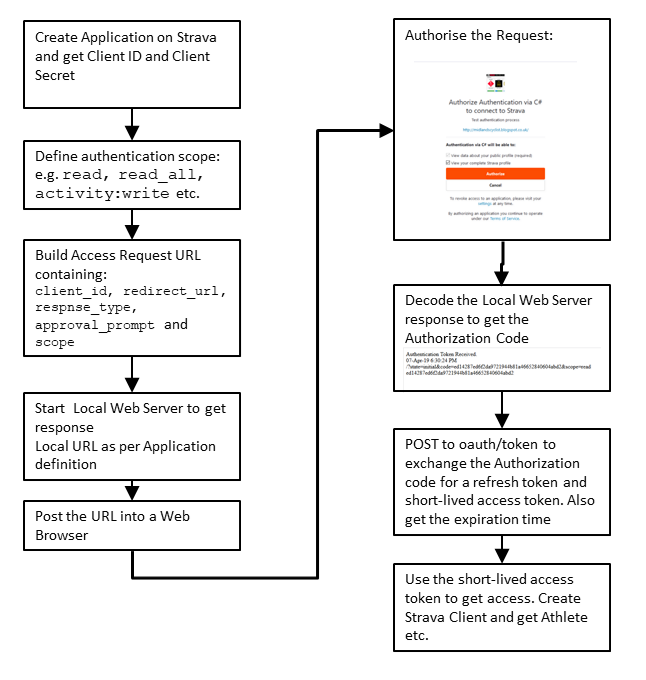
This a simplified flow diagram of how I believe it works:


There are some prerequisites -like needing a local web server running on your PC to receive the initial Authorisation code

I found a usable sample here: Simple C# Web Server. I don't understand how it works - all I know is that it does. Start the Web server before opening the web page, close it once you have a response. Note that this will open a web page and show the response rather than silently interpreting the reply.

This "waiting for a response" behaviour here also caused issues. We need to await the user authorising the Strava Request - at this point we are no longer in a pure Synchronous programming mode.

To address this I have user a timer to await the web server responding - this loops until either a timeout is reached or a successful authentication is achieved. I tried to use async and await but could not get this to work - I need to do more research and some other programme examples. Once we have the response from the Web server we can post to the Strava oauth link and get the short term access codes.

I believe that I have created a robust piece of code that does all of that and I wrote this in a small test application:


This application robustly returns codes and an expiry time. Initial testing in the main Strava application however got a "404 not authorised" response - this is where more testing is required, but as explained above has now been resolved by selecting the appropriate scope

Don't bother using these tokens as they are already expired!

The source code is here: Source Code. In theory, unzip the file, copy the contents into a folder, and using Visual Studio Open the solution "Strava_Autenticate_V3" (I could not spell "Authenticate" correctly!). Compile/build and it should run

Any feedback I would welcome, especially if there is an error.

Please note I am not a software developer - I am an engineer who can write software - I know there is a big difference. Again - for my poor design and coding - I am happy to receive constructive feedback


Saturday, 8 September 2018

Strava Data Analysis - A PC Based Visual C# Solution - V2.0.0.0 - Installation Issues Addressed

I have been happily progressing thinking that a few people might have downloaded my app and used it. I had no feedback but this does not mean its not being used - it could just as well mean it is being used and works as intended or did not do what people wanted. In reality I have written the app for myself as a learning and intellectual activity

However I was recently looking through the comments on this Blog and saw a comment saying:

"Just quickly tried this and got the following error:Downloading http://i5desktop/Strava Forms V1/Strava Forms V2.application did not succeed."

I had not realised there were errors deploying/installing but on reflection could see that I had never tested the installation using the zip file downloaded from my google drive. When I tried myself to deploy the zip file to my laptop I got the same error.

I have done a bit of googling and there are some restrictions and limitations when deploying using Visual Studio Express

However I have taken a slightly different approach and believe that there is now a zip file that will allow installation of my application.

It can be found here: Google Drive Link - the latest deployed version is 2_1_1_0_53


I can't be 100% sure that it will deploy but I am much more confidant that I was before.

There are a number of incremental changes and improvements since the last "release" - the biggest is probably that there is now a trace logger that I have been developing so I can identify and address issues that don't appear in the IDE. This is found by using the Menu option "Tools" - then select "Show Data Folder". In this folder will be files called e.g. Traceoutput_2018-09-01_11_50_09.txt - these are reasonably verbose and help debug and diagnose issues

However the software is very much a work in progress and I have a big list of things to do still

When installing you may get either of the following warnings (you probably will as the application is not signed in any way)


Please note that I have written this application for my own use and as far as I can tell it only does what it is meant to - acquire and display Strava data. Should anything happen to you PC whilst installing or using this then I cannot and will not take any responsibility

Sunday, 22 April 2018

Strava Data Analysis - A PC Based Visual C# Solution - V2.0.0.0 - Major Updates April 2018

The latest version is here: Strava Tool V3

Please use this version

Update of an Update:
I have been working through the issues seen when running the application standalone - ie outside of the debugger/IDE. As a consequence I now have a logger implemented in most areas which has resolved a number of the issues - ie it should run without too many Exceptions as I have trapped them or fixed the code. However there are still a number left and there is more work to do here - I realise that I should have done this sooner

It is however good enough to have another go at a release which is here:
Bristow Strava dot net app V2_1_1_0_34

I have made a few changes since the post below but apart from the logos and the icons its all been about error fixing

Note the log file is called "Traceoutput_yyyy_mm_dd-hh_mm_ss.txt" and can be found in the data folder from the menu option

Update
I believe some people are interested in this - it gets a reasonable amount of traffic. Whether people use the tool or not I am not sure as there has been very little communication about it, but IO have continued to plug away and add more feature. I had a bit of a break with other priorities but have had some time recently

This post will also show what's coming up - I was going to release the latest build with this post but when I published it it crashed all over the place (unlike the previous release in December) so I need to do some more testing

Here is a list (in oldest order) of all the pages I have prepared for this application. Please read in this order as the text does describe the application etc and how to use it - especially how to create the Strava token that you need to get either the Public or the Private data

  1. Release 1 
  2. Release 2 
  3. Release 3
  4. Release 4 

Here is some description of the newer features that have been developed:

Main (default) tab
Added some further Athlete data both tabular and graphical. It shows in a table the annual data summaries for number of rides, and total distance, elevation and time ridden. This is also presented graphically. It also details for each bike and the total, and the distance each has done.


Ride Activities tab
Activities for which the data has been downloaded to the local PC are now shown in red:


Ride Activities Statistics tab
Enhanced tabular and graphical views
If you have a power meter it will show a power curve - 1 second power, 20 second power etc (not shown if no power meter). The power data is also shown in a table. 

There is a table for some more enhanced statistics - the "Dr Coggan" power number (if have a power meter) and moving, climbing and pedalling ratio (%age of the total ride time). Some of these come from Veloviewer and some from the StravistiX plug in for the Chrome Browser

Ride Activity Graphs tab


The slider next to the data table allows the graph height to be increased or reduced


Clicking and holding the mouse over an area of the graph will zoom the x-axis over that region

Histogram tab
New - shows distribution of data points. Will show Speed. Power (Power Meter data only), Cadence, Heart rate, Temperature and gradient. If any of the data is not present the histogram will not be presented. Dependant on the number of histograms to plot the size and position will vary to give the biggest/best view

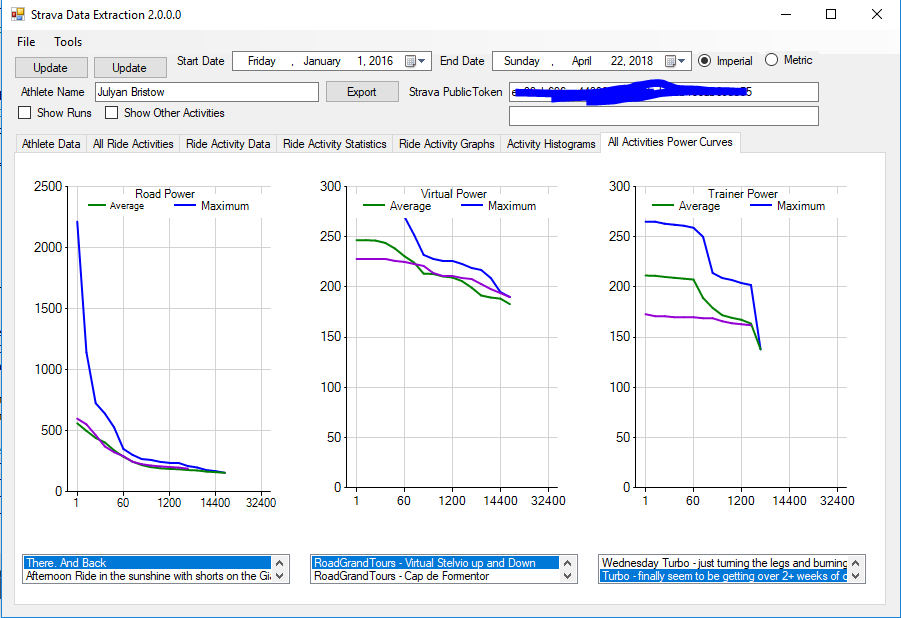
All Activities Power Curve tab (Power meter data only)
If you have a power meter (or a smart turbo that measure power) this will present the data n 3 graphs - one for road, one for "classic" turbo and one for virtual rides (like Zwift etc)
By default the maximum (blue) and average curves (green)  will be shown. Below the graph is a list of the rides of each type. Selecting on of the rides will show the corresponding data on the graph in purple

Next Steps
I have a list of enhancements to make, but clearly to get it to work when published seems pretty important first
Once this is achieved next improvements and features include:
  1. Adding manual data (like FTP)
  2. Seeing what else is available as a Premium member (I am not one)
  3. Adding a system logging process (so I can understand when and what issues occur when not running in the IDE) (in progress May 2018)
  4. A lot of code tidying - the more I write the more I see where I can make improvements (has started as part of #4)
  5. Some more statistic calculations
  6. The most important step now is I think to move the data from flat files into a proper database - this is now essential as there are potentially 4 files per activity plus a growing number of application summary files. This in elegant and I can see how using a data base will help manage and use the data. I understand the database process and strategy but I have never done this so it will be a major challenge
  7. Add code to manage the data usage for the API and pause when the limit is close
  8. Allow the system to update since the most recent update and add the new data to the existing data set rather than refresh the entire data set in the selected range
  9. Really try and manage the process to get a Token within the application - the current process is dreadful (although fortunately its a one off task generally)
As soon as I have a version that can be published I will do so